
Table of Contents
- What does it actually cost to develop a disposable camera?
- Australian film lab prices compared
- Develop-only vs develop and scan: which should you choose?
- Mail-in vs drop-off: how it works
- How long does developing take in Australia?
- What affects the price?
- Is it cheaper to develop multiple cameras at once?
- What do you get back?
- Frequently Asked Questions
- Ready to develop your camera?
The cost to develop a disposable camera in Australia sits between $19 and $31 AUD for a full colour develop-and-scan service at most reputable film labs. That price covers the chemical processing of your C-41 colour negative film and a digital scan you can download immediately. If you only want the negatives processed without a scan, most labs charge around $12 to $14 AUD.
Those numbers are the starting point. The final price depends on your lab, your scan resolution, whether you want prints, and how quickly you need it. This guide breaks down every variable so you know exactly what you are paying for before you hand over your camera.
Developed colour negative film from a disposable camera, ready for scanning and digital delivery.
What Does It Actually Cost to Develop a Disposable Camera?
Most Australians who develop a disposable camera for the first time are surprised that the developing cost is often as high as the camera itself. A $32 AUD disposable camera plus a $19–$25 AUD develop-and-scan fee means your total outlay is around $51–$57 AUD for 27 exposures, or roughly $1.89–$2.11 per shot.
That is not a criticism of the format. It reflects the genuine cost of chemical film processing, professional scanning equipment, and lab labour. Film photography is not cheap when you compare it to a free phone camera, but that is not the comparison people making it are interested in.
The price breakdown across a typical develop-and-scan service looks like this (prices as of 2026):
| Service tier | What's included | Approx. price (AUD) |
|---|---|---|
| Develop only | Chemical processing, negatives returned | $12–$14 |
| Develop + standard scan | Negatives + low/mid-res JPEGs | $19–$22 |
| Develop + high-res scan | Negatives + high-res TIFF or JPEG | $25–$35 |
| Develop + prints | Negatives + 4x6 prints | $22–$35 |
| Develop + scan + prints | Negatives + scans + 4x6 prints | $30–$45 |
Prices vary by lab, city, and current demand. Always confirm with your chosen lab before posting.
Australian Film Lab Prices Compared
Here are the labs most commonly used by Australian film shooters, with approximate prices where publicly listed. All prices are in AUD (prices as of 2026). Confirm directly with the lab before you send your camera, as pricing changes.
Hillvale, Melbourne VIC
One of Australia's most-used mail-in labs, Hillvale processes C-41 colour negative film including disposable cameras.
- C-41 develop + standard scan: approximately $19 AUD
- Develop only: approximately $12 AUD
- Turnaround: 3–5 business days
- Mail-in: yes, accepted nationally
- Website: hillvale.com.au
Do Film! Lab, Darlinghurst NSW
A Sydney lab popular with urban film shooters. Drop-off and mail-in both accepted.
- Develop only: from approximately $12 AUD
- Develop + standard scan: from approximately $19 AUD; check current lab sheet for additional scan tiers
- Turnaround: 3–5 business days standard
- Mail-in: yes
- Website: dofilmlab.com.au
FilmNeverDie, Melbourne VIC
Another well-regarded Melbourne lab with a strong online presence and mail-in service.
- C-41 develop only: approximately $12 AUD
- Develop + low-res scan: approximately $13.50 AUD; Develop + high-res scan: approximately $20 AUD
- Turnaround: 3–7 business days
- Mail-in: yes
Camera House (National chain)
Camera House has branches in most major cities (Brisbane, Perth, Adelaide, and more) and processes C-41 colour film in-store. Pricing varies by location.
- Develop + scan to email: approximately $19.95–$24.95 AUD
- Develop + prints: approximately $24.95 AUD
- Turnaround: same day to 1–3 business days depending on location
- Drop-off: yes, no mail-in at most locations
Big W Photo (National chain)
Big W photo centres process C-41 film at competitive prices and are accessible to regional customers.
- Develop + print: approximately $14–$18 AUD
- Digital scans: available at selected stores
- Turnaround: 3–7 business days
CAMDI Develop and Scan Service
CAMDI offers a develop-and-scan service for customers in Australia. It is particularly convenient if you bought your camera through the site.
- Visit /pages/disposable-camera-developing for current pricing and turnaround details.
Develop-Only vs Develop and Scan: Which Should You Choose?
This is the most important decision you make when pricing a developing job.
Develop only means the lab processes your film chemically and returns the physical negatives. You pay less, but you cannot see your images without a separate scanner. Unless you own a dedicated film scanner (which costs several hundred dollars) or have access to one at a library or community darkroom, develop-only is not a practical choice for most people.
Develop and scan means the lab processes your film and scans every frame to a digital file, usually delivered as a download link or USB. This is what most people want. You can see your photos on your phone or computer without any extra steps.
Standard scan vs high-resolution scan is a meaningful distinction. A standard scan at most labs is suitable for sharing on social media and printing at 4x6 or 5x7 inches. A high-resolution scan holds more detail and is better if you plan to print larger or crop heavily. For a disposable camera's plastic lens, a standard scan is usually sufficient; the lens resolution is the limiting factor, not the scan.
Prints are worth adding if you want physical copies. The per-print cost at most labs is low once the developing fee is already paid. If you plan to frame any shots or put them in an album, ordering prints at the same time as developing saves a second trip.
For most Australians developing a disposable camera, a develop and scan package at standard resolution is the right call. It costs more than develop-only, but the convenience of immediate digital access is worth the extra $8–$12 AUD.
Mail-In vs Drop-Off: How It Works
If you live in a major city with a film lab nearby, drop-off is the simplest option. You hand over your camera, the lab processes it, and you collect it when it's ready. No postage, no waiting on delivery.
For everyone outside Sydney, Melbourne, and inner Brisbane, mail-in is the normal approach. Australia's film labs have refined their mail-in processes well. Here is how it typically works:
- Package your disposable camera in a padded envelope or small box. Film is not light-sensitive once inside the camera, so standard postage is fine.
- Include your name, email address, and the service you want (develop + scan, high-res, prints, etc.). Many labs have an order form to include or an online booking system.
- Post to the lab. Standard Australia Post parcel post is fine. Some people use registered mail if they want tracking.
- The lab processes your film and emails a download link, typically within their stated turnaround time.
- If you also want physical negatives returned, most labs will post them back in a protective sleeve with a small return postage fee.
Regional and rural customers regularly send film from Far North Queensland, the Pilbara, regional Victoria, and Tasmania to Melbourne-based labs. The system works reliably.
How Long Does Developing Take in Australia?
Turnaround time depends on the lab and the service level.
| Lab type | Standard turnaround |
|---|---|
| In-store (Camera House, selected Big W) | Same day to 3 business days |
| Boutique mail-in lab (Hillvale, Do Film!, FilmNeverDie) | 3–7 business days after receipt |
| Budget chain mail-in | 5–10 business days |
Add Australia Post transit time to any mail-in estimate. Standard parcel post from most east-coast states to Melbourne or Sydney takes 2–5 business days; transit from WA or NT can take significantly longer (up to 9–15 business days). Total time from posting to receiving your download link is typically 7–12 business days for a mail-in order from the east coast, and potentially longer from WA or NT.
If you have a deadline (a wedding weekend, a birthday, an event), factor in this timing carefully. Order a week before the event is not enough. If you need the photos urgently, a same-day drop-off service at an in-store lab is your safest option.
What Affects the Price?
Film developing prices are set by a few consistent variables. Understanding them helps you compare labs accurately.
Scan resolution. The single biggest price driver beyond the base develop fee. Standard JPEGs cost less than high-resolution TIFFs. For a disposable camera with a plastic lens, standard resolution is usually sufficient.
Number of exposures. Most disposable cameras have 27 exposures. A few have 36. Some labs charge per roll regardless of exposure count; others price differently for longer rolls. Check the lab's pricing page.
Film format. Disposable cameras use 35mm film, which is the most common and cheapest format to process. Medium format (120 film) costs significantly more. You will always be on the cheaper 35mm tier with a disposable camera.
C-41 vs E-6 vs B&W. Disposable cameras use C-41 colour negative film. C-41 is the cheapest and fastest process. Black-and-white and slide film (E-6) cost more. This is a non-issue for disposable cameras, which are all C-41.
Rush processing. Most labs offer a rush option at a premium, typically 30–75% more than standard pricing, or a flat fee per roll; confirm the surcharge with your chosen lab.
Return postage. If you want your negatives physically returned after a mail-in service, expect a small return postage fee (approximately $5–$10 AUD).
Is It Cheaper to Develop Multiple Cameras at Once?
For event photography (weddings, parties, hen's nights), many people develop 8–15 cameras at once. Most labs do not offer per-roll volume discounts for small quantities, but the postage cost per roll drops significantly when you batch a larger order.
Posting 10 cameras in one parcel costs roughly the same in postage as posting 2 cameras. At $5–$8 AUD for tracked parcel post, batching 10 cameras into one order means your postage cost per camera is under $1.
For regular film shooters, developing two to three rolls at once (from a mix of cameras or regular 35mm) is a common way to reduce the per-roll effective cost.
If you are developing cameras from a large event, our guide to where to develop disposable cameras in Australia covers lab options city by city and includes tips for bulk orders.
What Do You Get Back?
After developing, most labs return the following:
Digital files. A download link (Google Drive, WeTransfer, or similar) containing one JPEG per frame. Standard scans are typically 3,000–4,000px on the long edge. High-res scans are typically 5,000–6,000px or more. Files are usually available for 30–60 days before the link expires, so download promptly.
Physical negatives. The processed film strip in a clear sleeve. Most labs include this automatically. The negatives are yours and last decades if stored properly. If you want them returned by post after a mail-in order, specify this when you book.
Prints (if ordered). Standard 4x6 prints on lustre or gloss paper. Some labs offer other sizes.
What you will not get back is the camera itself. Disposable cameras are opened by the lab to access the film. The camera body is kept by the lab for recycling or disposal. This is normal and expected.
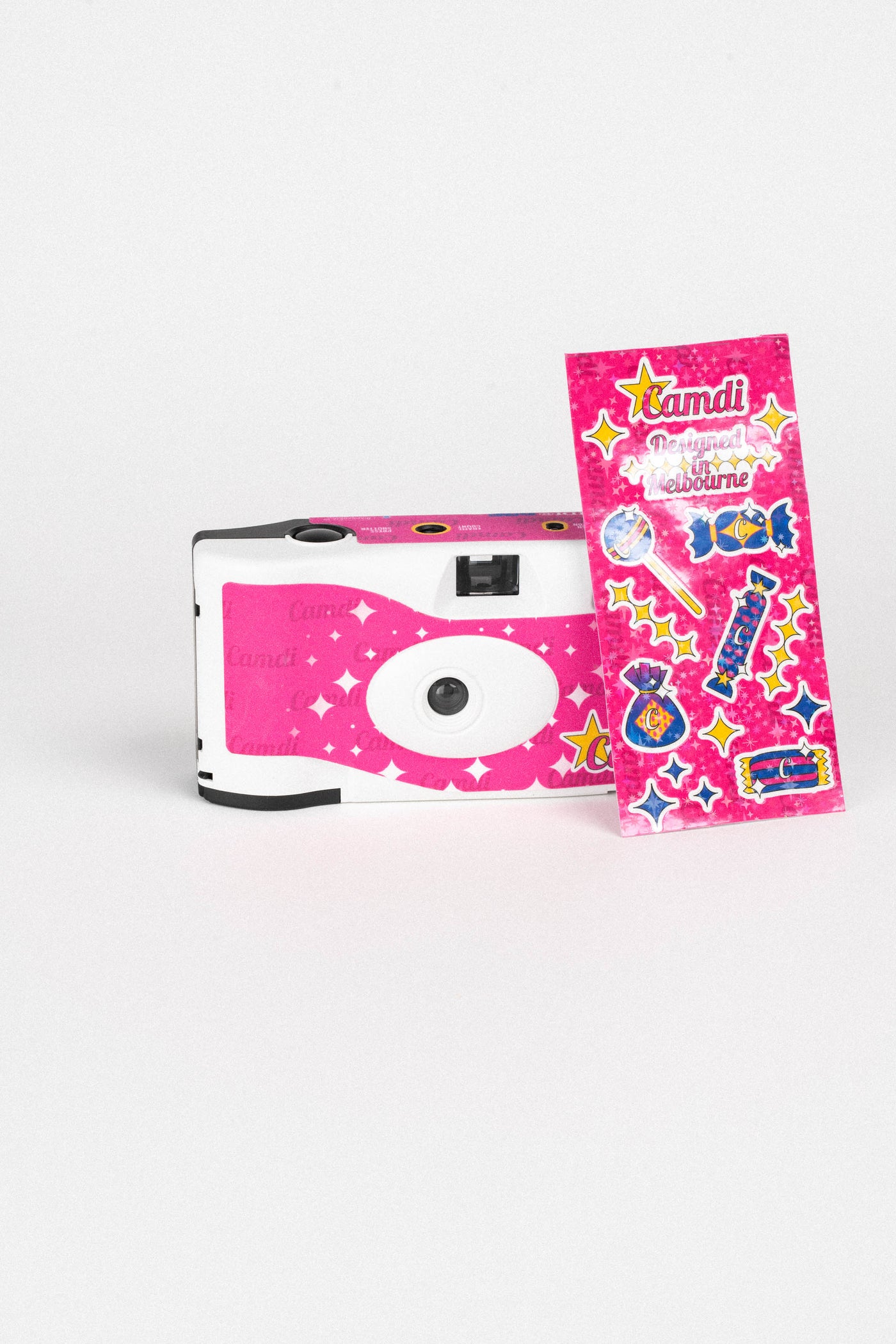 A CAMDI disposable camera, ready to shoot and develop. Hand the whole camera to a lab when your roll is finished.
Frequently Asked Questions
How much does it cost to develop a disposable camera in Australia?
Developing a disposable camera in Australia typically costs $19–$31 AUD for a colour develop-and-scan service at a reputable lab. Develop-only (no digital scan) is cheaper at $12–$14 AUD, but you need a separate scanner to view your images. The exact price depends on the lab, scan resolution, and whether you add prints.
Can I develop a disposable camera at Kmart or Big W in Australia?
Big W photo centres process C-41 film at selected stores across Australia, making them a convenient option for customers in suburbs where boutique film labs are not nearby. Kmart offers film developing at selected stores via Kodak Moments (in-store service only, not available online); turnaround is reportedly slow, check with your local store for current availability. For the best scan quality, a dedicated film lab is generally recommended over a chain photo centre.
How long does it take to develop a disposable camera in Australia?
Drop-off at an in-store lab takes 1–3 business days at most locations. Mail-in orders at boutique labs like Hillvale or Do Film! take 3–7 business days after the lab receives your camera, plus Australia Post transit time of 2–5 business days from east-coast states (significantly longer from WA or NT). Budget 7–14 days total for a mail-in order from most east-coast states, and allow more time if posting from WA or NT.
Is it worth getting high-resolution scans for a disposable camera?
For most disposable cameras, a standard scan is sufficient. The plastic lens limits fine detail, so a high-resolution scan captures more data than the lens actually resolved. Standard JPEGs are fine for social media, 4x6 prints, and screen viewing. If you plan to print larger than A4, a high-res scan is worth the extra cost.
Where is the cheapest place to develop a disposable camera in Australia?
Develop-only services at boutique labs (from approximately $12 AUD at Do Film! Lab and FilmNeverDie) and develop-and-print at Big W ($14–$18 AUD) are among the lower-cost options. Compare local options via Google Maps before posting. A nearby Camera House may offer competitive same-day pricing that undercuts postage-inclusive mail-in costs.
Can I develop a disposable camera myself at home?
Yes, with a changing bag, development tank, and C-41 chemistry (approximately $80–$120 AUD to set up), you can process colour negative film at home. It requires careful temperature control at 38°C. Most first-time film shooters find professional lab developing far more practical. Home developing makes sense only if you plan to process film regularly.
Ready to Develop Your Camera?
The cost to develop a disposable camera in Australia is real, but it is a known quantity. Budget $19–$31 AUD for a develop-and-scan service at a reputable lab, factor in postage if you are mailing in, and allow 7–14 days for the full process if you are outside a major city (and potentially longer from WA or NT).
CAMDI's develop and scan service is available for customers who bought their camera through the site. For a broader look at labs across Australia, the guide to where to develop disposable cameras in Australia covers your options city by city.
If you are thinking about the total cost of shooting on film beyond just developing, our 2026 disposable camera pricing guide breaks down camera costs alongside developing to give you the full per-shot picture.
If you are curious about the film inside your camera, 35mm film types explained covers everything from ISO to film stock character, so your next roll is an informed choice.
Sources and pricing references:
- Hillvale film lab (Melbourne): hillvale.com.au
- Do Film! Lab (Sydney): dofilmlab.com.au
- FilmNeverDie (Melbourne): filmneverdie.com
- Camera House pricing: camerahouse.com.au
- Internal CAMDI product and service references: thecamdi.com.au
All prices are indicative ranges based on publicly available information as at June 2026. Confirm current pricing directly with your chosen lab before ordering.


