
Table of Contents
- The quick verdict
- What is a disposable camera?
- What is a reusable film camera?
- Head-to-head comparison
- The real cost breakdown in AUD
- Image quality: what actually differs?
- Ease of use and convenience
- Sustainability and environmental impact
- When a disposable camera wins
- When a reusable camera wins
- Buying guide for Australia
- Developing your film in Australia
- Frequently Asked Questions
- Ready to shoot?
Choosing between a reusable vs disposable camera comes down to one question: how often do you plan to shoot on film?
For a one-off event, a gift, or a first-ever taste of analogue photography, a disposable camera is genuinely hard to beat. You peel the backing, start shooting, and hand it in at the end. If you picture yourself loading rolls on weekend trips to the Blue Mountains or Bondi, a reusable 35mm point-and-shoot will save you real money and give you more creative options within a few rolls.
Both formats have a place. This guide breaks down every meaningful difference so you can pick the right one for your situation.
The Quick Verdict
Buy a disposable if: you need a camera for a single event, you're buying for someone else, or you want the simplest possible introduction to film with no commitment.
Buy a reusable if: you plan to shoot more than two or three rolls, you want to experiment with different film stocks, or the per-shot cost matters to you over time.
Not sure yet? A disposable is the lower-stakes way to discover whether film photography is for you before spending more.
What Is a Disposable Camera?
A disposable camera (also called a single-use camera) comes pre-loaded with a roll of colour-negative film, typically 27 exposures. The most common specs are a fixed aperture of roughly f/10 to f/11, a shutter speed of around 1/100s, and a plastic lens with a fixed focal length (usually 30 to 32mm equivalent). Most include a built-in flash.
You shoot through the roll, advance with a small thumb wheel, and return the whole camera to a film lab. The lab opens the camera, develops the film, and scans it. You never see the inside.
Popular Australian-market options include:
- Kodak Funsaver (ISO 800, 27 exposures, approx. $32 AUD)
- Fujifilm Quicksnap Flash 400 (ISO 400, 27 exposures, approx. $32 AUD)
- Fujifilm Quicksnap Marine (waterproof, great for pools and surf, approx. $32 AUD)
- Hillvale re~di (recycled disposable camera, 24 exposures, approx. $27 AUD)
The CAMDI disposable range adds a design-forward angle to the format. Browse the CAMDI disposable collection to see what's available locally.
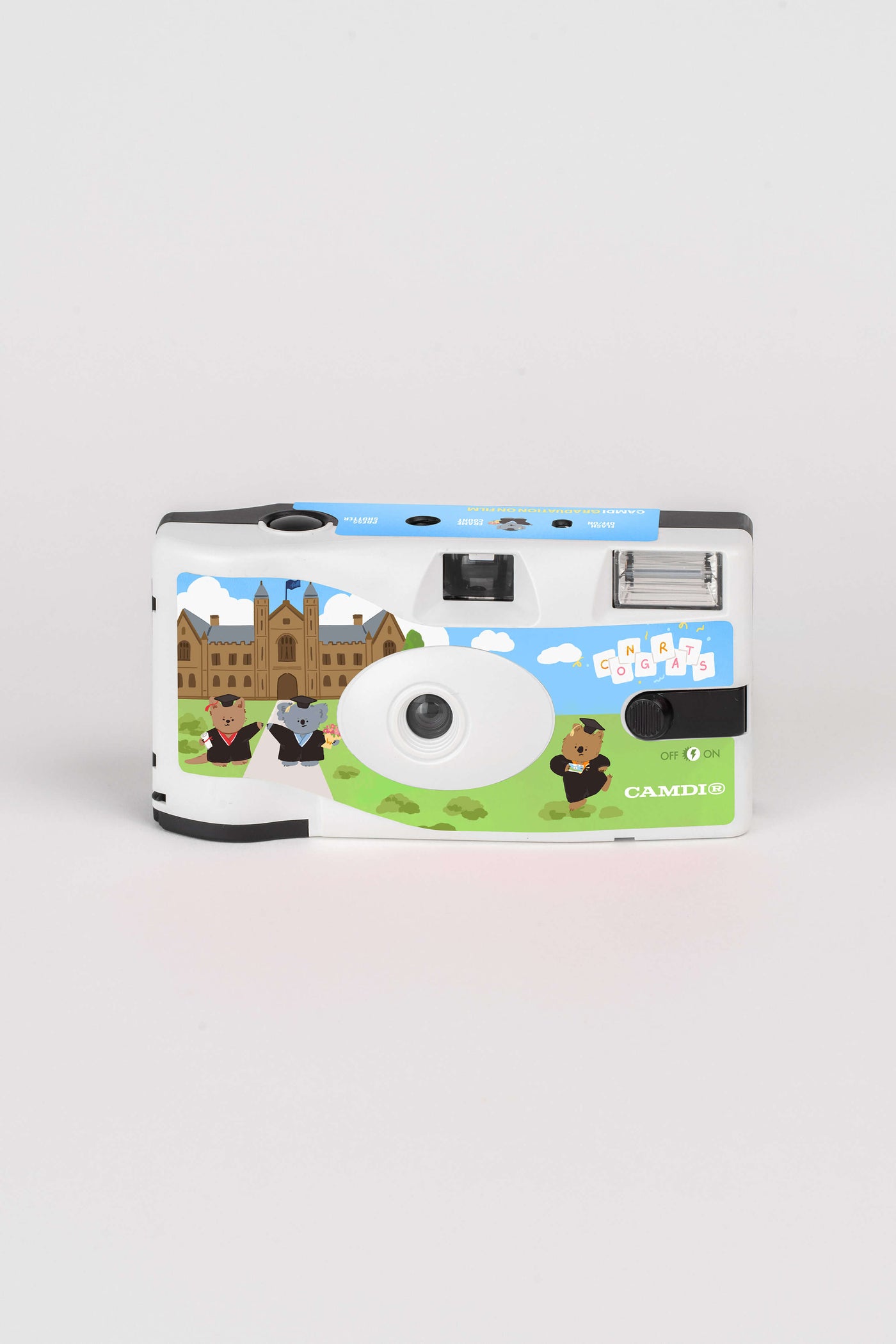 CAMDI's disposable cameras come pre-loaded and ready to shoot straight out of the box.
What Is a Reusable Film Camera?
A reusable film camera is exactly that: you load a new roll of film each time you shoot. The camera itself lasts indefinitely. Within the reusable category there are a few distinct types.
Plastic point-and-shoots are the entry-level choice. Cameras like the Kodak M35, Kodak M38, and Ilford Sprite 35-II sit in the $43 to $50 AUD range. They have a fixed plastic lens, a basic flash, and a simple film-advance mechanism. Easy to use, genuinely fun.
Compact 35mm film cameras sit a step up in quality. The Olympus Mju ii (now a cult classic) and similar compact cameras use glass lenses and often include automatic exposure. Prices on the secondhand market for these have climbed substantially over recent years, so acting early makes sense.
 Compact 35mm point-and-shoots like the Olympus range use glass lenses for sharper results. Photo: "Olympus Stylus, XA, XA2" by Ivan Radic, CC BY 2.0.
35mm SLRs like the Canon AE-1 give you shutter-priority automatic and full manual exposure modes, interchangeable lenses, and the deepest creative range. They're heavier and have a steeper learning curve, but the image quality ceiling is much higher.
At CAMDI, we focus on disposable cameras: every CAMDI camera is a single-use, 27-exposure model with a built-in flash. For reusable film cameras, the Kodak M35 and Ilford Sprite 35-II are strong entry-level picks, and the CAMDI disposable collection is the place to start if you want a beautifully designed single-use option.
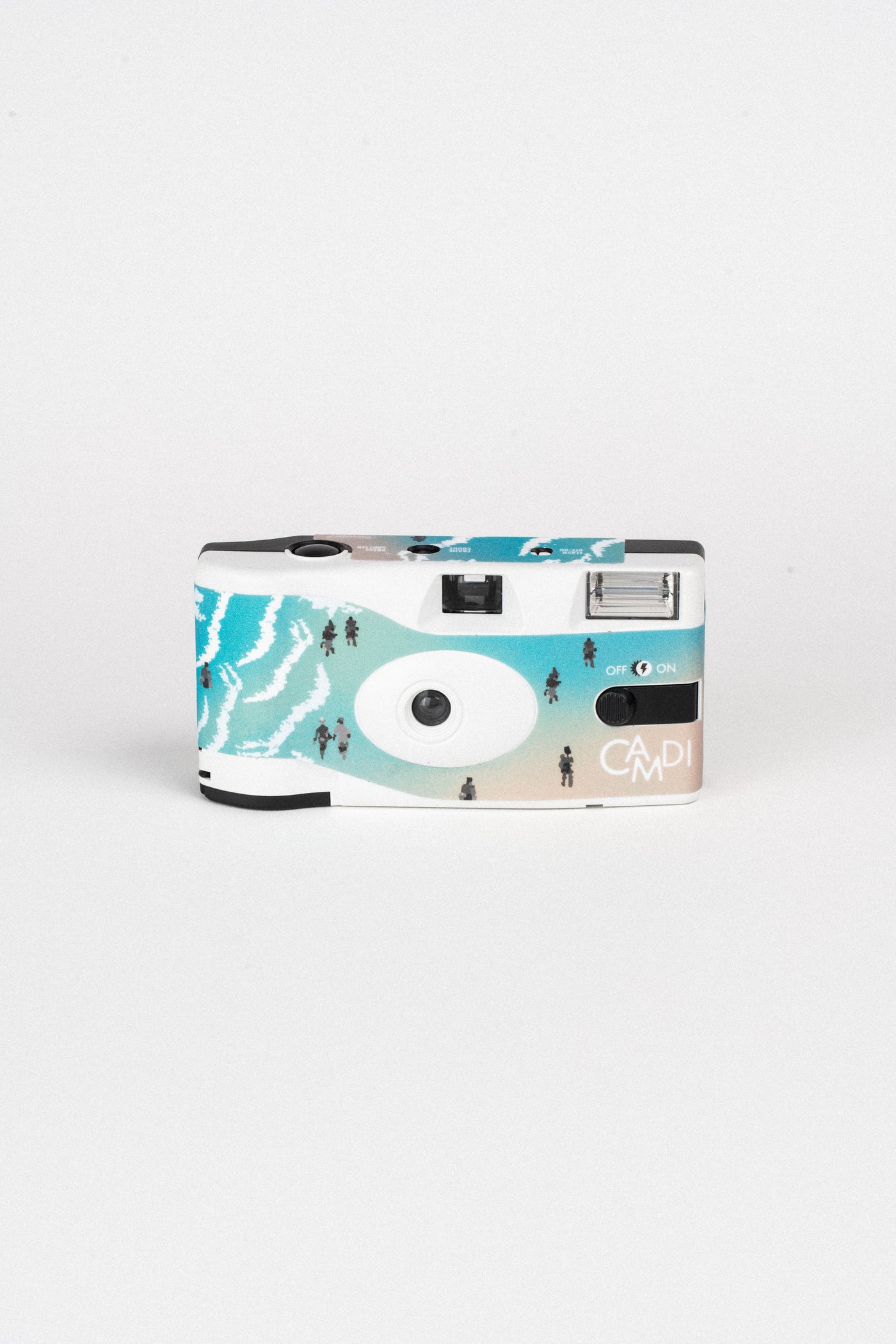 The Coast by CAMDI is a single-use disposable film camera, pre-loaded and ready to shoot from beach days to city streets.
Head-to-Head Comparison
| Feature | Disposable Camera | Reusable Film Camera |
|---|---|---|
| Upfront cost (AUD) | $27-$32 | $43-$60 (entry-level) |
| Cost per shot (first roll) | ~$1.89 | ~$2.31 |
| Cost per shot (ongoing) | ~$1.89 every time | ~$1.11 from roll 2 onward |
| Break-even point | Never cheaper | After ~3-4 rolls |
| Image quality | Decent; plastic lens, fixed ISO 400 or 800 | Better; film stock choice, higher-quality lens options |
| Creative control | None (fixed settings) | Moderate to high (film choice, some exposure settings) |
| Ease of use | Extremely simple | Easy after first load |
| Film loading | Pre-loaded, no action needed | Load and rewind yourself |
| Flash | Built-in | Built-in on most entry-level models |
| Best for | Events, gifts, one-off occasions | Regular hobby, cost efficiency, creative development |
| Sustainability | Higher per-roll waste | Much lower ongoing waste |
| Film stock choice | Fixed (usually ISO 400 or ISO 800 colour, depending on brand) | Any 35mm film you like |
The Real Cost Breakdown in AUD
This is where the conversation gets concrete. Here is what you actually spend.
Disposable camera: total cost
A Kodak Funsaver or Fujifilm Quicksnap runs around $32 AUD at JB Hi-Fi, Camera House, or online at CAMDI. Add developing and scanning.
At Hillvale in Melbourne (one of the most-used mail-in labs in Australia), C-41 colour develop plus a standard scan costs approximately $19 AUD. Turnaround is usually two to five business days.
- Camera: ~$32
- Develop + scan: ~$19
- Total for 27 shots: ~$51 AUD
- Cost per shot: ~$1.89
That price is the same every single time you buy a new disposable. There is no amortisation.
Reusable camera: total cost
Take a Kodak M35 at approximately $43 AUD. Your first roll might be Kodak Ultramax 400 (36 exposures, around $20 to $22 AUD) plus the same $19 develop-and-scan fee.
- Camera: ~$43
- First roll of film: ~$21
- Develop + scan: ~$19
- Total for first roll of 36 shots: ~$83 AUD
- Cost per shot (roll 1): ~$2.31
That looks more expensive. But from roll two onward, the camera is already paid for.
- Roll of film: ~$21
- Develop + scan: ~$19
- Total per roll ongoing: ~$40 AUD for 36 shots
- Cost per shot (roll 2+): ~$1.11
The break-even point arrives after roughly 3 to 4 rolls, depending on current film prices. From that point, you're saving around 41% per shot compared to buying a new disposable each time.
If you shoot one roll a month, a reusable camera can pay for itself in under four months.
Image Quality: What Actually Differs?
Both formats produce real 35mm film negatives, so both carry that characteristic grain, colour depth, and organic imperfection that makes film worth using.
The differences come from three factors.
The lens. Disposable cameras use a simple, single-element plastic lens. It produces soft edges, mild distortion, and limited sharpness. Some people love this look. A reusable plastic point-and-shoot like the Kodak M35 has a similar plastic lens, but dedicated compact cameras and SLRs use glass lenses that produce sharper, more detailed negatives.
ISO and film stock. Disposables are locked to their factory film, usually ISO 400 or ISO 800 colour negative depending on the brand. ISO 800 produces noticeably more grain, which reads as texture in good light and as muddy shadows in low light. With a reusable camera you can load whatever 35mm film suits the situation: Kodak Ultramax 400 for bright outdoor days, Kodak Portra 400 for portraits with silky skin tones, Ilford HP5 Plus for black-and-white, or Fujifilm 400 for an affordable all-rounder.
Exposure control. A disposable is fixed at roughly f/10 to f/11 and 1/100s. It exposes the same way in a sunny park and under a canopy at a wedding. A reusable camera, even a basic one, lets you choose film stocks suited to the light conditions.
The grain aesthetic from a disposable is genuinely charming, and plenty of photographers deliberately reach for one when they want that raw, party-photo energy. For sharpness, tonal range, or the ability to shoot in different conditions, a reusable will give you noticeably better results over time.
Film photography's warmth and depth is achievable with both formats, though reusable cameras give you more control over the look.
Ease of Use and Convenience
On pure convenience, disposables win without argument. There is nothing to learn. You open the box, find the shutter button, hold it roughly level, and press. No film loading, no rewinding, no caring about which end is which. You hand the whole camera to a lab at the end.
Reusable cameras require a few extra steps. Loading film correctly (especially in low light or from memory at a festival) has a small learning curve. Forgetting to rewind the film before opening the back is a real mistake that exposes and ruins your shots. If the camera needs new batteries, you need to remember.
That said, the basics are not difficult. Most people get comfortable loading a 35mm camera on their second try. If you are new to all of it, our guide to film photography for beginners in Australia covers exactly this.
For events where cameras are shared between guests, disposables make more practical sense. Nobody needs to explain rewinding to a tipsy guest at midnight.
Sustainability and Environmental Impact
Reusable cameras have a clear advantage here, though the full picture is more nuanced than "disposables = bad."
A disposable camera contains a plastic body, metal components, a small flash circuit, and spent silver-halide chemicals from the developed film. Most labs recycle the camera body and often recover the film silver. Manufacturing a new camera for every 27 shots does generate more material waste per shot than shooting 10 rolls through a single reusable body.
The Hillvale re~di is worth mentioning here. It is an Australian recycled-plastic disposable in a semi-closed loop, made from collected used camera bodies. It costs around $27 AUD for 24 exposures and is a reasonable middle ground if you want a disposable but care about the materials.
Reusable cameras are not zero-waste either. Film processing uses chemicals, film cassettes become waste, and entry-level plastic cameras are still manufactured goods. Spread across 10, 20, or 30 rolls, the environmental cost per shot is significantly lower.
If sustainability is part of your decision, a reusable camera is the more thoughtful long-term choice.
When a Disposable Camera Wins
Disposables are the better tool in specific situations. Here is when to reach for one without hesitation.
Weddings and events. Placing disposables on guest tables is a tradition for good reason. Guests shoot candidly, you collect the cameras at the end, and you get 200+ unposed moments you would never have planned. Nobody needs a briefing.
Music festivals. Mosh pits, sweaty crowds, midnight light shows: a $32 camera you can afford to lose or damage is the right call.
Beach, pool, or waterways. The Fujifilm Quicksnap Marine is waterproof and purpose-built for water environments. No reusable entry-level camera competes here.
Gifts. A disposable camera is one of the better tangible gifts for someone who appreciates film photography but does not want to commit to more gear. Browse the CAMDI disposable collection for options that come ready to gift.
Children and teenagers. Zero risk to an expensive camera. Complete simplicity. The results are often genuinely charming.
A first-ever film experience. If you are curious about film but not ready to invest, a disposable lets you find out if the format is for you before spending more.
When a Reusable Camera Wins
The case for reusable cameras gets stronger the more you shoot.
Regular film shooting. If film photography becomes even a monthly thing, the numbers quickly favour a reusable. Three to four rolls and you are ahead.
Choosing your film stock. The ability to load Kodak Portra for a portrait session, Ilford HP5 for a moody black-and-white day, or Kodak Ultramax for bright weekend light is a real creative advantage. The film stock you choose is a fundamental part of the look.
Building a craft. Film photography teaches you to slow down, compose deliberately, and commit to a frame. A reusable camera, especially one with some manual control, deepens that process in a way a disposable does not.
Ongoing travel photography. Bringing a reusable 35mm point-and-shoot on a trip to South-East Asia or around regional Australia is lighter than a DSLR, cheaper per shot than a disposable, and produces images with a quality that rewards the effort.
Environmental preference. A reusable camera generates significantly less waste per shot over its lifetime, as covered above.
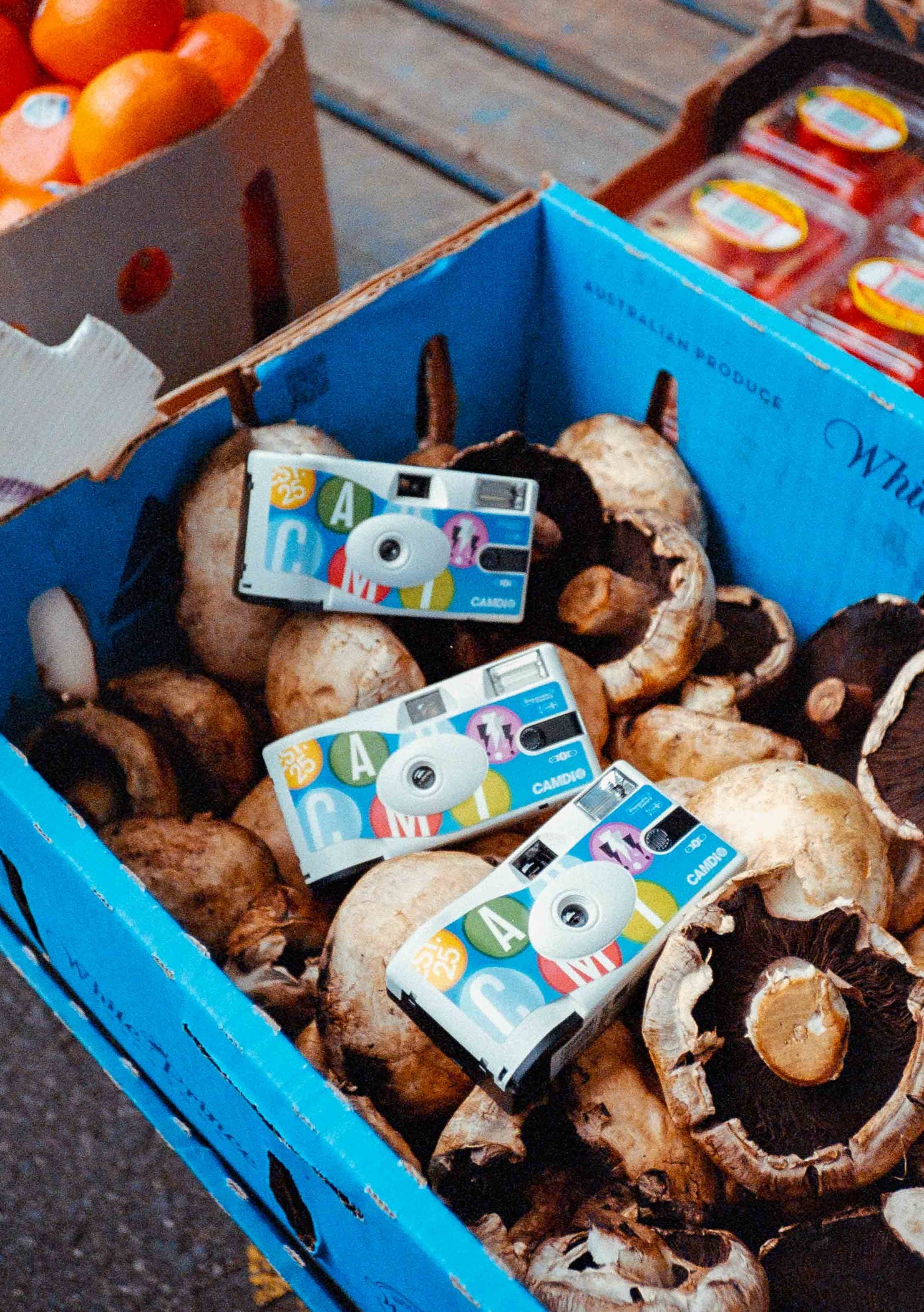 A reusable 35mm camera is compact enough to carry anywhere, from a summer road trip to a Sunday market.
Buying Guide for Australia
Where to buy disposable cameras in Australia
Disposable cameras are widely available across the country:
- JB Hi-Fi and Big W stock Kodak and Fujifilm disposables in-store
- Camera House and Ted's Cameras carry a broader range including Ilford
- Irohas Photo (online) stocks disposables alongside film and developing supplies
- Hillvale (Melbourne) carries the re~di recycled disposable and a range of film stocks
- CAMDI (thecamdi.com.au) sells its own designed disposable cameras with Australian shipping
Where to buy reusable film cameras in Australia
Entry-level reusable cameras are available from most of the retailers above, plus:
- Georges Cameras (Sydney) for a broader selection including vintage cameras
- Australian Analog for community-driven film camera purchasing advice
- Surfolk: an Australian-designed reusable 35mm brand worth knowing about
- Photo Access (Canberra) carries a solid range for ACT-based shoppers
If you are also considering an instant camera, our comparison of disposable cameras vs Instax vs Polaroid covers that territory.
Developing Your Film in Australia
Once you have shot a roll, you will need a lab to develop and scan it. Here are the main options used by Australian film shooters in 2026. (Prices as of 2026; labs update their pricing periodically, so check directly for the latest.)
Hillvale (Melbourne): One of Australia's most well-regarded film labs. C-41 colour develop plus standard scan is approximately $19 AUD, negatives-only develop around $12 AUD. Turnaround 2 to 5 business days. Mail-in available nationally.
Do Film! Lab (Darlinghurst, Sydney): Popular with Sydney-based film shooters. Develop from approximately $12 AUD. Develop + standard scan from approximately $19 AUD.
FilmNeverDie (Melbourne): Develop from approximately $12 AUD. Develop + high-res scan from approximately $20 AUD. Mail-in accepted.
Adelaide Photo Factory (Adelaide): A South Australian option with a solid reputation for C-41 processing.
For regional shooters anywhere from Cairns to Hobart, mail-in labs are reliable and well-practised at handling film sent from across the country. Pack your roll in a padded envelope and most labs will return scans digitally within their standard turnaround.
Frequently Asked Questions
Is a reusable film camera worth it in Australia?
Yes, if you plan to shoot more than three or four rolls. From roll two onward, the cost per shot on a reusable camera drops to around $1.11 AUD, compared to roughly $1.89 per shot on a disposable. A basic reusable like the Kodak M35 pays for itself after about three to four rolls, depending on current film prices.
How much does it cost to develop a disposable camera in Australia in 2026?
Most Australian labs charge approximately $19 to $25 AUD for colour C-41 develop plus a standard digital scan. Negatives-only develop runs around $12 AUD at most labs, with variation depending on the lab and any express surcharges. Mail-in labs such as Hillvale (Melbourne) and Do Film! Lab (Sydney) are the most commonly used options nationally.
Are disposable cameras good quality compared to a 35mm film camera?
Disposable cameras produce decent results in good light but are limited by a plastic lens and a fixed ISO 400 or ISO 800 setting (depending on the brand). A reusable 35mm camera, even an entry-level plastic model, typically delivers sharper results and lets you choose your film stock. For candid, party-style photography, the disposable look is part of the appeal.
How many shots do you get on a disposable camera in Australia?
Most disposable cameras sold in Australia come with 27 exposures. The Hillvale re~di has 24 exposures. Some disposables sold internationally include 39 exposures, but 27 is standard at Australian retailers. A reusable camera loaded with a 36-exposure film roll gives you more shots per roll.
What is the best reusable film camera for beginners in Australia?
The Kodak M35 (approximately $43 AUD) and Kodak M38 (approximately $49.95 AUD) are popular starting points: affordable, simple to use, and available from most Australian camera retailers. The Ilford Sprite 35-II is another solid option at around $44.95 AUD. The Lomography Simple Use is a budget-friendly option worth considering if you want something a little different.
Are disposable cameras bad for the environment?
They produce more per-shot waste than reusable cameras because a new body is manufactured for every 27 shots. Most labs do recycle the plastic body and recover silver from processing chemicals. For ongoing film shooting, a reusable camera reduces material waste significantly. The Hillvale re~di is a more sustainable single-use option made from collected used camera bodies.
Ready to Shoot?
The reusable vs disposable camera question rarely has one right answer. It has a right answer for you, based on how you actually plan to use the camera.
A wedding, festival, party, or one curious experiment? A disposable camera is the right move. Browse the CAMDI disposable collection for options designed to feel good in your hands and produce results worth keeping.
Ready to commit to film as a regular practice? A reusable 35mm camera costs less per shot, gives you more creative range, and produces the kind of images that make you reach for it again. The Kodak M35 and Ilford Sprite 35-II are solid starting points for reusable film shooting.
Whichever you choose, the images you get back from a film lab still carry something digital can't quite replicate. A little slower. A little warmer. Worth the wait.
If you are still finding your feet with the format, our film photography for beginners guide is a good next read.
Sources:
- Hillvale (Melbourne) film lab pricing: https://hillvale.com.au
- Kodak Funsaver product information: https://www.kodak.com
- Fujifilm Quicksnap product information: https://www.fujifilm.com/au
- Internal CAMDI product and pricing references: thecamdi.com.au


